Why We Fail: AI Edition

The history of IT is filled with failed projects. Your AI project is probably the next in this long line of abject failure. Here’s why.
It’s not really a surprise when an IT project fails. Depending on which estimate you believe, somewhere around 50-60% of IT projects fail. Yes, you read that right: most of them fail. We also know that AI projects have an even higher failure rate than that. Again, this depends on who you ask, but many analysts say that up to 80% of AI projects fail.
That’s a pretty distressing number. But, I’m not surprised.
That’s because I literally wrote a book about this many years ago: Why We Fail. That book is about enterprise private cloud adoption so the technical examples in it are not really relevant today; but sadly, the underlying issues addressed in that book are very relevant for today.
And the underlying reason can be expressed in one diagram:
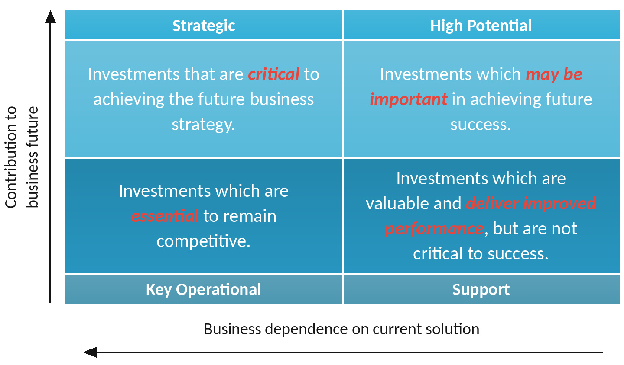
This grid was developed by Cranfield School of Business many years ago but it’s as true today as it was then. The reality is that when you buy technology for a business, you really need to know WHY you are buying it so that you can manage the project effectively. This grid very neatly breaks technology down based on how dependent the business is on that technology today vs. your expectation of how much it will contribute to the business’s future. This gives you four segments:
High Potential: These are things which MAY be important in the future but aren’t right now. So, for example, many enterprise IT organizations have brought AI into the business with an expectation that this will improve the business in the future, but they don’t really know and it’s not directly contributing to the bottom line today.
Strategic: These are things which are actively supporting critical business functions right now and will help the business grow or compete in the future. For a company like Vercel, AI is Strategic and they’ve pivoted their entire company around it.
Key Operational: These are things which the business absolutely depends on even if it’s not really helping the future business growth or competitiveness. So, for a bank, things like check processing software are absolutely Key Operational and must be done even if they don’t gain much competitive advantage from them.
Support: These are things you do, but you don’t really have to do. So for many companies systems like email have become key operational and they choose to outsource them. Many key operational projects are managed strictly on a cost basis. These are normally commodity items and you buy them from the lowest bidder.
The really interesting thing about this model is that only the business decision maker can decide which box each project goes into. This isn’t a technology decision, it’s a business decision. Thus, the IT group needs to get buy-in from the business owners to ensure that IT projects are closely aligned to business goals. This also means that two different companies may evaluate the same technology in different ways. AI for example is often High Potential for most enterprise companies, but it’s Key Strategic for many software companies.
Similarly, a single technology tends to move through the grid over time. Starting at Key Strategic and working it’s way down to Support. This graphic talks about the history of the ATM over time and how it moved through different phases:
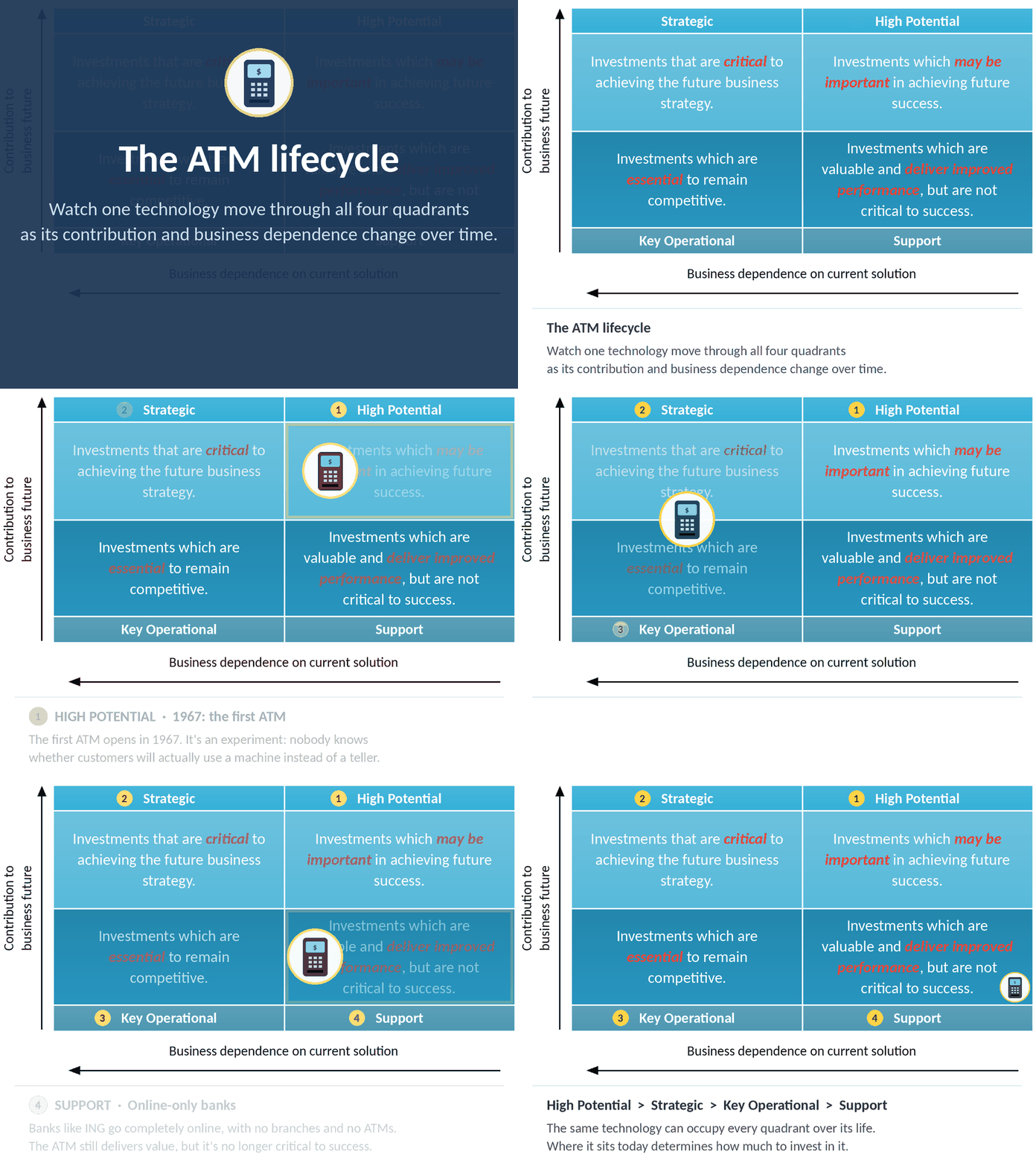
What is interesting is that for Bank of America, ATM’s are still “Key Operational” and they operate a very large network of ATMs globally. But for a bank like ING Bank, they don’t have branches at all and they consider ATM’s a “support” activity which they farm out to independent ATM networks. Most technologies will have a spread like this because the businesses they support will have different business strategies. And this is the real lesson: the technology must support the business, not the other way around.
So, how does all this apply to AI and the failure rate of AI projects in the enterprise?
Well, if you look closely at these AI projects, you will commonly see one or more of these issues:
- The project does not have a business goal. If you tell me that you want to “have an AI strategy” then I know that you will probably fail. There should be no such thing as an AI strategy in your company. You should have a customer success strategy using AI or an employee productivity strategy, or a market acquisition strategy. All or none of these may use AI to execute these strategies, but unless you are selling AI software, AI is not the purpose of the exercise. AI is just a tool, not the goal.
- The project does not have a business sponsor who owns a defined metric. Every IT project should support a specific business goal. So, if your goal is to reduce time to resolve customer support cases by 50%, the VP who owns customer support better sign up for that goal. Otherwise, why are you doing it? And if you’re not measuring it, how will you know if you succeeded?
- The project is pushed top down. Most top down IT projects fail. The reality is that tools like AI need use cases and those use cases come from the people doing the work. If you want to introduce AI to the business, start with hackathons. Have employees play around with it, figure out what it’s good for and then pitch leadership with specific things that they think they can do to improve the business.
- The project is time based rather than goal based. Most IT projects that have goals like “deploy Claude Enterprise to 80% of employees in six weeks” will fail simply because they’re focused on the doing rather than the improvement. The reality is that the timescale is way less important than the actual business goal. So, you should be focused on, “customer support cases are resolved in 50% of the time with the same or better customer satisfaction score.” That’s an actual project. How long will that take? Who knows? But if you are making progress towards that goal, you’re much more likely to be successful.
- Internal politics. Most IT projects wind up falling into territorial disputes. Something like AI breaks down barriers. If you simply pave over the cowpaths and keep your current business processes and current org structure, you’ll probably get the same result. You need to be holistic in your thinking. Processes will need to change, org structures will need to change. Focus on the ideal outcome rather than the way you do things now.
To summarize: Focus on the business outcome. What will be different when you’re done than today? Who owns that? How will you measure that? Will the person who owns that metric agree that your project has improve the metric? How will you measure success?
If you can cover these basic questions, your odds of success will increase massively.