What are they building?

Over the past six months, I’ve been heavily engaged in the vibe coding community. As part of my research in developing the “Mindful AI Coding” course on Maven, I’ve examined the work of hundreds of vibe coders.
What’s interesting to me is that while some of the common wisdom about vibe coding does turn out to be true, many of the things you read online seem to be false based on the actual evidence.
What’s true
As most people would expect, the vibe coding community is largely untrained and thus they accept the default functionality of AI coding tools. This means that it’s common to see vibe coded apps which have little or no security reviews built in and they often don’t have any sort of code pipeline or other automated testing.
What isn’t true
On the other hand, the cries of “SaaS is dead” seem to be overblown. There are hundreds of small SaaS projects running every day along with hundreds of other random software projects. The vast majority of these seek to be some sort of commercial software. Of course, most of these will fail, but that’s not news. Most software products fail.
In fact, SaaS is still the most popular deployment model. I’ve pulled tools out here by themselves because those are always deployed as part of the larger ecosystem they support. Apps in this case are basically all apps you install locally, whether desktop or mobile.
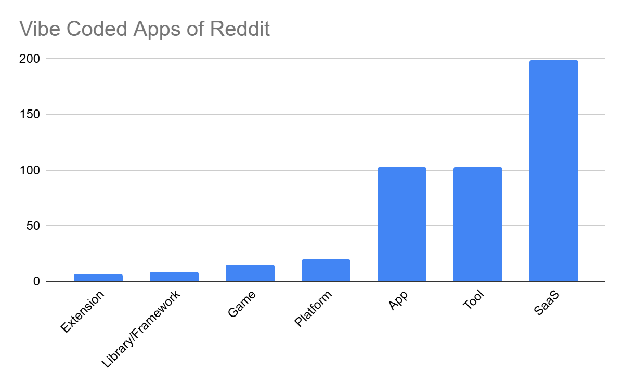
Inside that SaaS bucket, you also see quite a bit of variety:
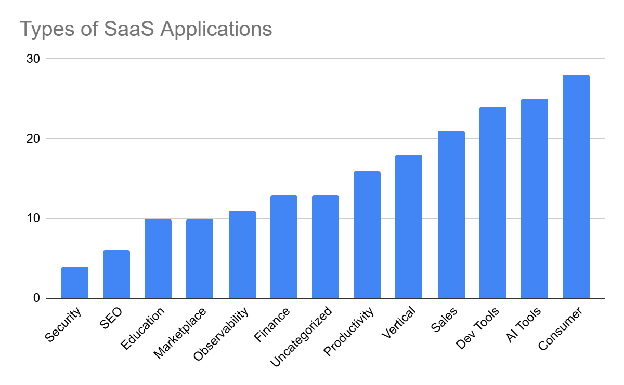
While consumer is the most popular, there is a pretty good spread and no single type of SaaS application really dominates the data.
Of course, it’s not really a surprise that dev tools and AI tools are very popular for vibe coding. It’s pretty much a meme that everyone and their brother is trying to sell you an AI tool. What does surprise me is the stubborn dominance of consumer SaaS. Despite predictions, consumer SaaS is still the number one thing that vibe coders are building. This hasn’t changed for at least the last five years.
My take on this is that while the shift in the market to smaller teams is quite real, the death of software is very much overblown. It’s very common to see solo non-technical founders online asking for help once they hit a massive wall using AI site builders. In the end, you still own the code and you still need to maintain it.
I think this partially explains the sentiment analysis I did last month:
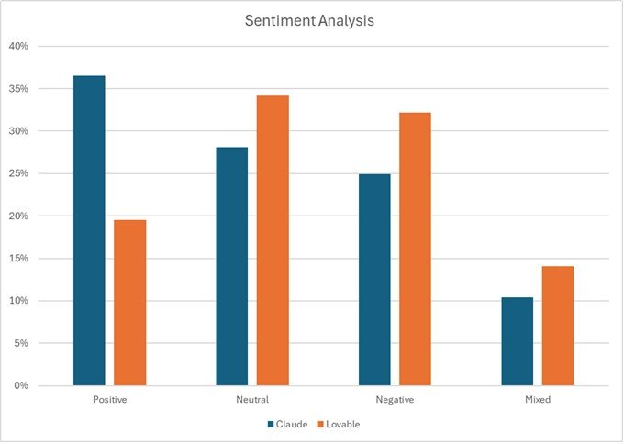
Looking at the verbatims, the overall theme here seems to be that Lovable users struggle as they get deeper into the product. To put it another way, the customers are looking for outcomes that the product doesn’t support. This also plays into the larger “vibe coding” discourse on social media. While I don’t consider this data to be authoritative, it would be concerning if I worked at Lovable. Insert all the disclaimers here: small sample size, audience targeting, etc. They’ve got an amazing product, but no product is perfect. Work to be done.
And this is the lesson: You own the customer outcome. That outcome is what customers think it should be, not what you think it should be.